
Are you Looking For
Heat Treatment For Aluminium Castings?
THE PROCESS – YOUR QUESTIONS EXPLAINED
What is heat treatment in aluminium?
Heat treatment is a controlled process used to alter the mechanical properties of aluminium alloys. It involves heating and cooling the material in specific stages to improve strength, hardness, and overall performance without changing the shape of the component.
Why is aluminium heat treated?
Aluminium is heat treated to increase its strength and durability. Certain alloys respond particularly well to heat treatment, allowing them to be used in demanding applications such as automotive, aerospace, and structural components where performance is critical.
What are the main stages of aluminium heat treatment?
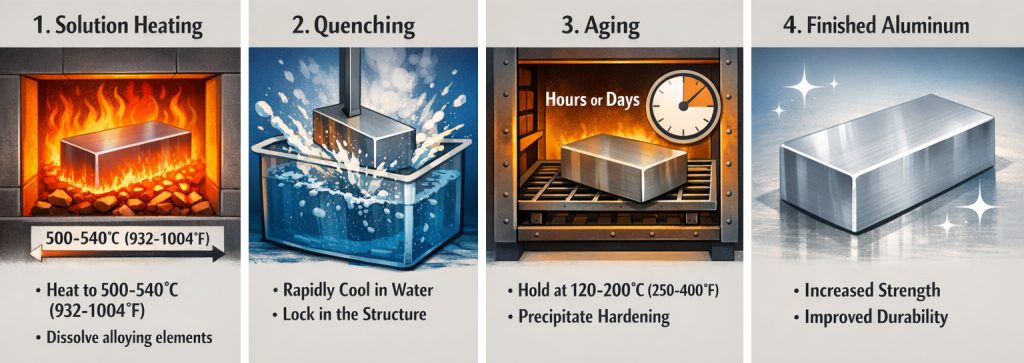
The process typically involves three key stages: solution heat treatment, quenching, and ageing. Each stage plays a specific role in modifying the internal structure of the aluminium to achieve the desired properties.
What happens during solution heat treatment?
During solution heat treatment, the aluminium is heated to a high temperature, typically between 480°C and 540°C depending on the alloy. This allows alloying elements such as magnesium or silicon to dissolve into a solid solution, creating a uniform structure.
What is quenching and why is it important?
Quenching involves rapidly cooling the aluminium, usually in water. This step locks the dissolved elements in place, preventing them from forming larger particles and preserving the material in a soft but unstable state ready for strengthening.
What is ageing in aluminium heat treatment?
Ageing is the final stage where the material is reheated to a lower temperature or left at room temperature. During this stage, fine particles form within the aluminium structure, significantly increasing strength through a process known as precipitation hardening.
What is the difference between natural and artificial ageing?
Natural ageing occurs at room temperature over time, while artificial ageing is carried out in a controlled furnace at elevated temperatures. Artificial ageing provides faster and more consistent results, making it the preferred method in most industrial applications.
Does heat treatment affect all types of aluminium?
Not all aluminium alloys can be heat treated. Heat-treatable alloys, such as those in the 2xxx, 6xxx, and 7xxx series, respond well to the process. Non-heat-treatable alloys gain strength through work hardening instead.
How does heat treatment improve aluminium performance?
Heat treatment refines the internal microstructure of aluminium, increasing its tensile strength, hardness, and resistance to wear. It also improves consistency across components, which is essential for precision engineering applications.
Is heat-treated aluminium more durable?
Yes, when properly processed, heat-treated aluminium offers significantly improved durability and performance. It is better suited to handle stress, load, and environmental exposure compared to untreated material.
At Bridge Aluminium Foundries, heat treatment forms an important part of the aluminium casting process for customers that require controlled and consistent material properties. Heat treatment is not applied as a default solution but is used where specifications or applications call for additional control over strength, stability or performance characteristics. Our approach remains practical and aligned with agreed technical requirements rather than overstated outcomes. Heat treatment is a controlled thermal process used to alter the mechanical properties of aluminium castings. By carefully heating and cooling components under defined conditions, properties such as strength, hardness and dimensional stability can be influenced.
Heat treated castings are typically specified where components are required to perform reliably under mechanical load or within demanding operating environments. The process of heat treatment is selected based on alloy type, casting method and customer specification. Different aluminium alloys respond in different ways to thermal processing, which is why heat treatment parameters are established in line with material standards and drawing requirements. Our role is to ensure that heat treated castings are processed consistently and in accordance with these defined parameters. Find out more about giving extra life to your aluminum components with our finishing services.
Do We Cover Your Area?
Enter your UK postcode or US ZIP code below.
Finding The Right Service for You
IMPORTANT FACTORS
Heat treated castings are often specified to support improved consistency across production runs. By applying controlled thermal cycles, variation in material properties can be reduced, helping ensure castings perform as expected within their intended application. Heat treatment supports predictability rather than guaranteeing absolute performance, and outcomes remain dependent on design, material selection and operating conditions. Dimensional stability is another key reason heat treatment may be specified. Aluminium castings can experience internal stresses during solidification and cooling. Heat treatment can help relieve these stresses, supporting improved stability during subsequent machining or assembly operations. Heat treated castings may therefore offer greater consistency during downstream processing, particularly where tight tolerances are required. Heat treatment is commonly integrated into the wider manufacturing workflow.
Castings may be treated before machining, allowing material properties to stabilise prior to final dimensional work. This sequencing helps reduce the risk of movement or distortion later in the process. Planning treatment at the correct stage supports efficiency and consistency without introducing unnecessary complexity. Quality control remains central throughout the treatment process. Parameters such as temperature, time and cooling rates are monitored to ensure treated castings are processed in line with agreed specifications. Where required, records are maintained to support traceability and verification. These controls help ensure repeatability across batches and provide confidence in the consistency of output.
Why Choose us for Heat Treatment?
Sustainability is also considered when applying heat treatment. Aluminium’s recyclability and long service life already contribute positively to sustainability goals. Treatment can support these benefits by helping extend component lifespan and reducing the likelihood of premature replacement. Processes are planned with efficiency in mind, balancing performance requirements with responsible energy use. Experience plays a key role in applying treatment effectively. Understanding how different alloys and casting designs respond to thermal processing allows appropriate methods to be selected. Treated castings benefit from this practical knowledge, ensuring processes are applied where they add value rather than as a blanket solution.
Communication with customers remains an essential part of the process. Heat treatment requirements are discussed early to ensure expectations around material properties, lead times and production sequencing are clearly understood. This collaborative approach helps ensure heat treated castings align with the wider project requirements and manufacturing objectives. By focusing on controlled processes, consistency and clear communication, treatment supports the production of aluminium castings that meet defined specifications. Heat treated castings are supplied as part of an integrated manufacturing approach, with an emphasis on reliability, repeatability and realistic outcomes rather than exaggerated claims.